Which holds up during periods of stress and does 24/7 liquidity provided by cryptocurrency truly enable managing gap up risk?
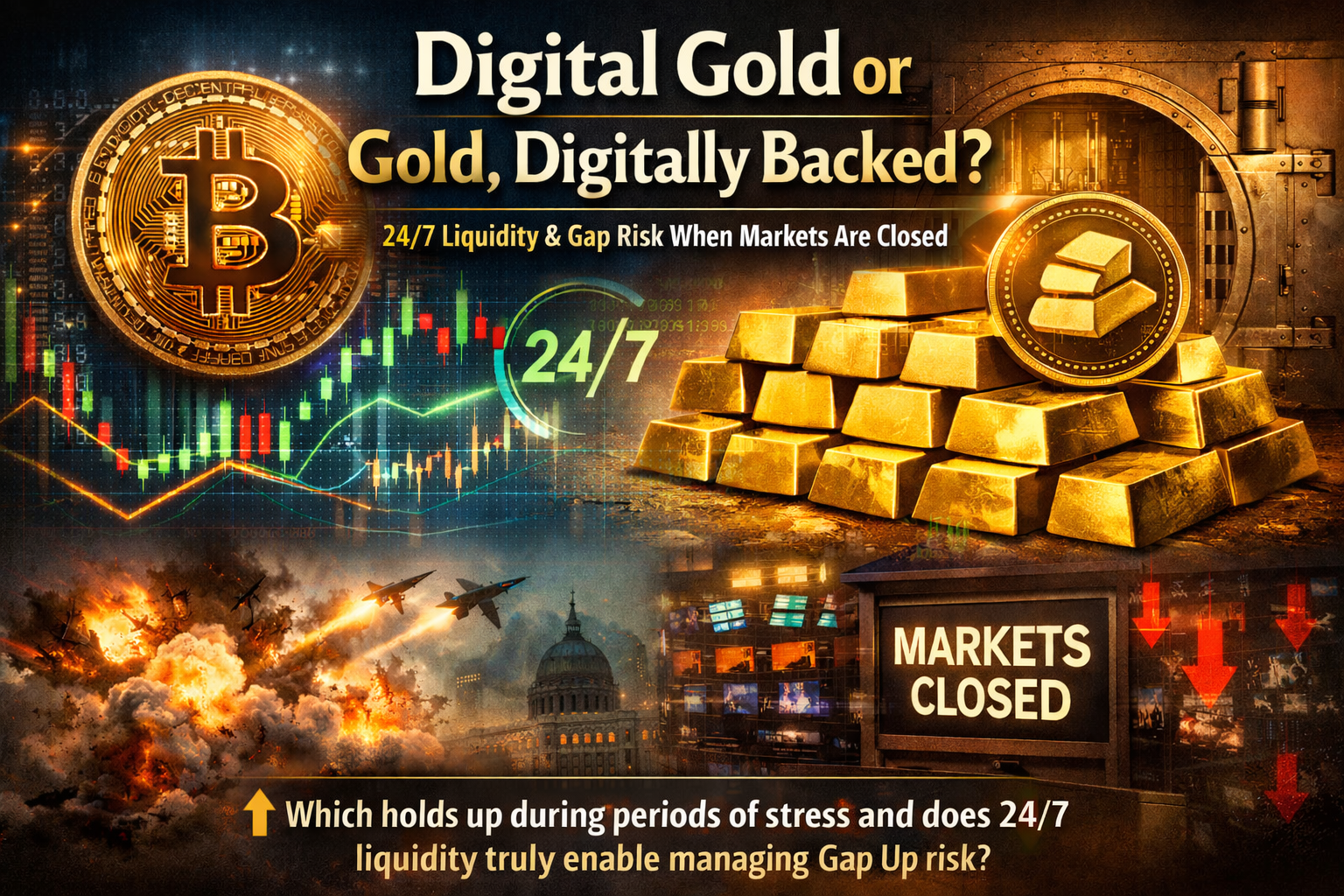
Does 24/7 Liquidity Really Protect You When Markets Close — And Do Crypto Assets Help Manage Gap-Up Risk When Markets Are Closed?
Let’s talk about “digital gold.”
On one side, we have Bitcoin — marketed as the future of money, mathematically scarce, decentralized, and backed primarily by belief.
On the other side, we have tokenized gold like XAUT — a digital token backed by something far less philosophical: real, physical gold sitting in vaults.
Both trade 24/7. Both claim to offer protection. But only one is directly tied to a hard asset humans have trusted for 5,000 years.
So here’s the real question: When markets close and risk doesn’t — which one actually behaves like gold?
Let’s unpack this.
BTC popularity leading to The Leveraged Bitcoin Treasury Experiment
BTC was and still remains the talk of the town. So much so that Michael Saylor’s transformation of MSTR into a leveraged Bitcoin treasury has convinced many investors that this is a new financial playbook.
The strategy is simple in structure:
- Raise capital (including convertible bonds)
- Buy Bitcoin
- Repeat
- Call it treasury optimization
As of the latest reporting, roughly $50 billion worth of Bitcoin sits on the balance sheet. Yet those holdings are approximately 10% underwater relative to cost basis.
Management’s reassurance? Bitcoin would need to fall roughly 90% — to around $8,000 — and remain there for years before the Bitcoin reserve no longer fully covers net debt.
From a balance sheet math perspective, that sounds reassuring. From an investor psychology perspective, it raises a harder question:
Will shareholders patiently hold through volatility for three years waiting for the thesis to play out?
Strong hands sound impressive during earnings calls. They’re harder to maintain when portfolios are blinking red.
XAUT’s Growth and Market Position
Since its launch, XAUT has steadily grown into one of the largest tokenized gold products in the market, with billions of
dollars’ worth of physical gold reportedly backing its circulating supply. It has navigated multiple crypto cycles, liquidity
crunches, and regulatory scrutiny while maintaining close tracking to physical gold prices.
Over time, XAUT has expanded across major crypto exchanges and attracted both crypto-native traders and raditional
gold investors seeking flexibility. Its growth reflects demand for assets that combine the stability of physical bullion with
the portability and settlement speed of blockchain infrastructure. While it carries issuer and custody considerations —
as any asset-backed structure does — its sustained adoption suggests the market sees value in having gold
accessible on digital rails, particularly in a world where capital moves faster than traditional exchange hours allow
Is 24/7 Liquidity Cryptocurrency’s Saving Grace?
One genuine advantage of digital assets is continuous trading.
Crypto does not close. There is no Friday bell. There is no “see you Monday.”
Liquidity exists 24 hours a day, 7 days a week.
But that raises important questions:
- Is thin weekend liquidity the same as institutional liquidity?
- Is price discovery meaningful when traditional markets are offline?
- Or is it simply volatility without depth?
And most importantly:
What happens when geopolitical risk escalates after traditional markets have closed?
When Risk Doesn’t Wait for Monday
Late last weekend, geopolitical tensions between the United States and Iran escalated significantly.
Going into the weekend, spot gold was trading around $5,200–$5,250 per ounce as tensions were already elevated.
Then, late Friday evening EST (roughly 8:00 PM to midnight), coordinated U.S. and Israeli strikes on Iran were reported, including the killing of senior leadership figures.
This was not rhetoric. This was a clear military escalation.
The timing mattered.
Global spot gold markets and COMEX futures were closed. Traditional price discovery was paused.
But tokenized gold markets were still open.
What Happened While Official Markets Were Closed?
During the weekend:
- Tokenized gold proxies traded higher.
- Prices rose roughly 1.0% to 1.8% overnight.
- Crypto-linked gold markets began pricing in safe-haven demand.
By the time official markets reopened on Monday, gold opened higher — effectively catching up to what weekend trading had already begun pricing.
Snapshot of the Event
| Category | Observation |
|---|---|
| Spot gold before weekend | ~$5,200–$5,250 |
| Escalation | Coordinated U.S.–Israeli strike on Iran |
| Timing | Late Friday EST / Early Saturday Middle East |
| Official gold markets | Closed |
| Tokenized gold reaction | +1.0–1.8% over weekend |
| Monday open | Higher |
In this instance, tokenized gold acted as a bridge for price discovery while traditional markets were offline.
The Gap Risk Reality
Here’s the uncomfortable truth for traditional market participants:
When exchanges close on Friday:
Risk does not close. Headlines do not pause. Wars do not wait.
If you hold unhedged positions over the weekend, you are exposed to gap risk at Monday’s open.
Yes, you can hedge before the close. But hedging:
- Changes the payoff structure
- Reduces upside
- Alters the strategy’s original risk profile
There is always a trade-off between protection and participation.
So how valuable is 24/7 liquidity?
Is it psychological comfort? Or is it structural risk management?
Digital Gold vs Digitally Backed Gold
Bitcoin represents scarcity without physical backing. Tokenized gold represents digital access with physical collateral.
Bitcoin offers decentralization and continuous liquidity. Tokenized gold offers asset backing and continuous trading.
The weekend escalation presented a real-world stress test. Tokenized gold repriced immediately. Traditional gold repriced when markets reopened.
The deeper question is whether that weekend liquidity represents:
- True institutional depth
- Or thin reactive trading
And whether it meaningfully reduces risk — or simply shifts it.
I Invite Your Thoughts
I’m genuinely curious how you think about this.
- How do you manage weekend gap risk in your portfolio?
- Should global exchanges move toward 24/7 trading if everything is already electronic?
- What structural or regulatory constraints prevent 24/7 liquidity in traditional markets?
- Do proxies like XAUT provide real price discovery — or just weekend volatility?
If another escalation happened tonight, what would you rather be holding?
Bitcoin? Tokenized gold? Hedged futures? Or cash and calm nerves?
Drop your thoughts below. Debate is welcome.
Because conviction is one thing. Liquidity — precisely when you need it — is another.hing far less philosophical: real, physical gold sitting in vaults.
Both trade 24/7. Both claim to offer protection. But only one is directly tied to a hard asset humans have trusted for 5,000 years.
So here’s the real question: When markets close and risk doesn’t — which one actually behaves like gold?
Let’s unpack this.
The Leveraged Bitcoin Treasury Strategy
Michael Saylor’s transformation of MSTR into a leveraged Bitcoin treasury has convinced many investors that this is a new financial playbook.
The strategy is simple in structure:
- Raise capital (including convertible bonds)
- Buy Bitcoin
- Repeat
- Call it treasury optimization
As of the latest reporting, roughly $50 billion worth of Bitcoin sits on the balance sheet. Yet those holdings are approximately 10% underwater relative to cost basis.
Management’s reassurance? Bitcoin would need to fall roughly 90% — to around $8,000 — and remain there for years before the Bitcoin reserve no longer fully covers net debt.
From a balance sheet math perspective, that sounds reassuring. From an investor psychology perspective, it raises a harder question:
Will shareholders patiently hold through volatility for three years waiting for the thesis to play out?
Strong hands sound impressive during earnings calls. They’re harder to maintain when portfolios are blinking red.
Is 24/7 Liquidity Cryptocurrency’s Saving Grace?
One genuine advantage of digital assets is continuous trading.
Crypto does not close. There is no Friday bell. There is no “see you Monday.”
Liquidity exists 24 hours a day, 7 days a week.
But that raises important questions:
- Is thin weekend liquidity the same as institutional liquidity?
- Is price discovery meaningful when traditional markets are offline?
- Or is it simply volatility without depth?
And most importantly: What happens when geopolitical risk escalates after traditional markets have closed?
When Risk Doesn’t Wait for Monday
Late last weekend, geopolitical tensions between the United States and Iran escalated significantly.
Going into the weekend, spot gold was trading around $5,200–$5,250 per ounce as tensions were already elevated.
Then, late Friday evening EST (roughly 8:00 PM to midnight), coordinated U.S. and Israeli strikes on Iran were reported, including the killing of senior leadership figures.
This was not rhetoric. This was a clear military escalation.
The timing mattered.
Global spot gold markets and COMEX futures were closed. Traditional price discovery was paused.
But tokenized gold markets were still open.
What Happened While Official Markets Were Closed?
During the weekend:
- Tokenized gold proxies traded higher.
- Prices rose roughly 1.0% to 1.8% overnight.
- Crypto-linked gold markets began pricing in safe-haven demand.
By the time official markets reopened on Monday, gold opened higher — effectively catching up to what weekend trading had already begun pricing.
Snapshot of the Event
| Category | Observation |
|---|---|
| Spot gold before weekend | ~$5,200–$5,250 |
| Escalation | Coordinated U.S.–Israeli strike on Iran |
| Timing | Late Friday EST / Early Saturday Middle East |
| Official gold markets | Closed |
| Tokenized gold reaction | +1.0–1.8% over weekend |
| Monday open | Higher |
In this instance, tokenized gold acted as a bridge for price discovery while traditional markets were offline.
The Gap Risk Reality
Here’s the uncomfortable truth for traditional market participants:
When exchanges close on Friday:
- Risk does not close.
- Headlines do not pause.
- Wars do not wait.
If you hold unhedged positions over the weekend, you are exposed to gap risk at Monday’s open.
Yes, you can hedge before the close. But hedging:
- Changes the payoff structure
- Reduces upside
- Alters the strategy’s original risk profile
There is always a trade-off between protection and participation.
So how valuable is 24/7 liquidity?
Is it psychological comfort? Or is it structural risk management?
Digital Gold vs Digitally Backed Gold
Bitcoin represents scarcity without physical backing. Tokenized gold represents digital access with physical collateral.
Bitcoin offers decentralization and continuous liquidity. Tokenized gold offers asset backing and continuous trading.
The weekend escalation presented a real-world stress test. Tokenized gold repriced immediately. Traditional gold repriced when markets reopened.
The deeper question is whether that weekend liquidity represents:
- True institutional depth
- Or thin reactive trading
And whether it meaningfully reduces risk — or simply shifts it.
I Invite Your Thoughts on the Following
I’m genuinely curious how you think about this.
- How do you manage weekend gap risk in your portfolio?
- Do cryptocurrencies in general and gold proxies like XAUT in particular provide real price discovery — or just weekend volatility?
- If another escalation happened tonight, what would you rather be holding before US markets open tomorrow?
Bitcoin? Tokenized gold? Hedged futures? Or cash and calm nerves?
Drop your thoughts below. Debate is welcome.
Because conviction is one thing. Liquidity — precisely when you need it — is another.
 Assorted Musings