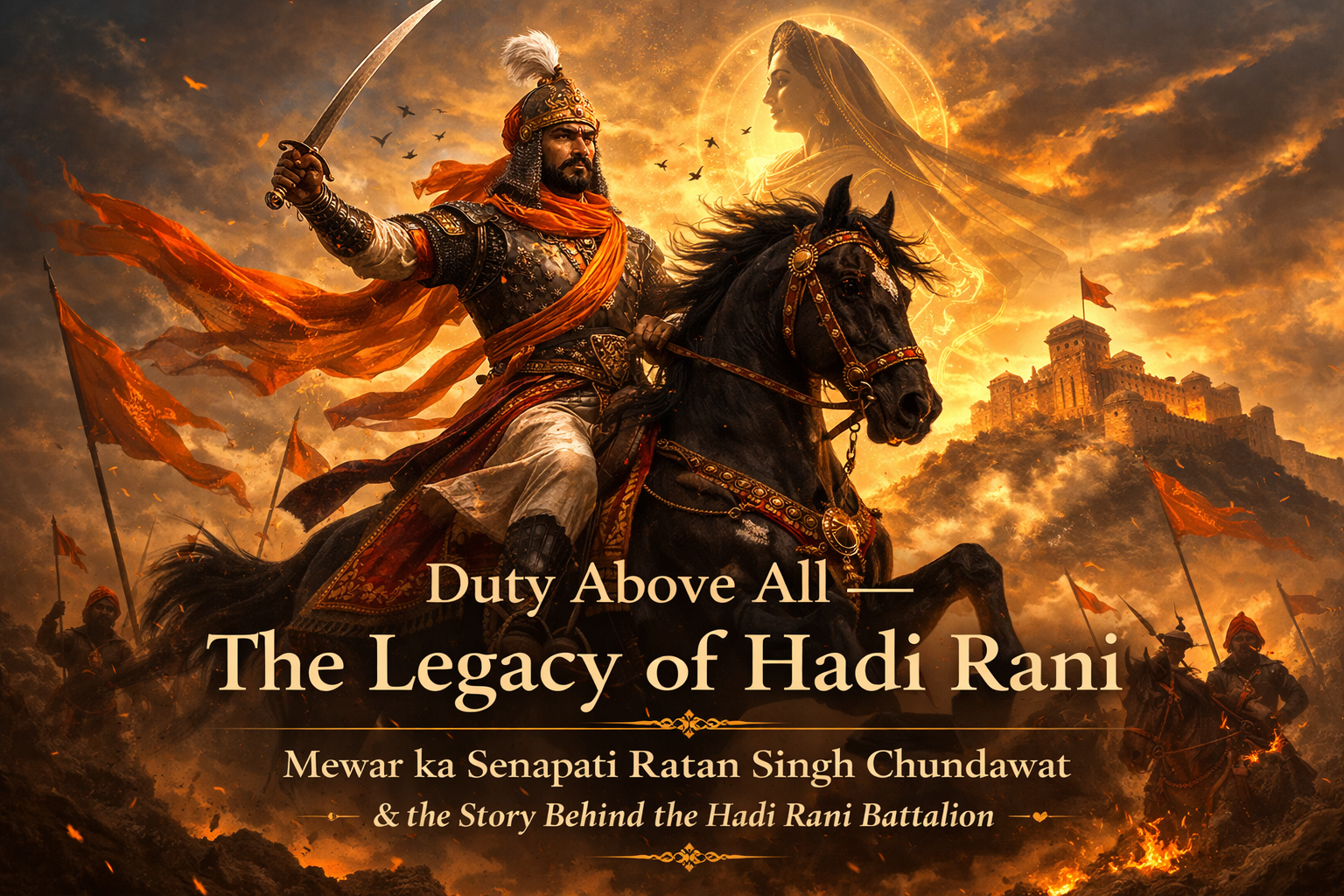
(Mewar ka Senapati Ratan Singh Chundawat & How the Hadi Rani Battalion Got Its Name)
Context
This blog post is inspired by a powerful narration on the YouTube channel Ateetgram, curated and presented by Rajveer Sir. Ateetgram is dedicated to bringing alive India’s untold history, Rajasthan’s royal grandeur, and the timeless spirit of Bharat’s art and culture. With over 24,000 subscribers and millions of views, the channel has become a meaningful platform for students, history enthusiasts, and seekers who wish not just to memorize history — but to feel it.
📺 Original Video: https://www.youtube.com/watch?v=5RkFP2U9a6E&t=1s
🔗 Channel: https://www.youtube.com/@Ateetgram
Ateetgram’s mission is to preserve and revive Bharat’s heritage, honor unsung heroes, and present history with pride, clarity, and authenticity. Rajveer Sir’s distinctive style blends historical narration with relatable humor, modern analogies, and emotional depth — making complex historical events accessible to today’s youth.
This article has been created using the Hindi transcript of the above video and translated into English with the assistance of AI tools, including ChatGPT, to make the story accessible to a wider audience. However, translation inevitably leads to some loss of fidelity. Rajveer Sir’s tone, timing, cultural nuance, and ability to make history conversational and engaging — especially his perfectly timed jokes, modern references, and classroom-style punchlines — cannot be fully replicated in written English form (AI tries, but it doesn’t yet have Rajveer Sir’s dramatic pauses or eyebrow expressions).
While this blog aims to faithfully preserve the essence and historical narrative, readers are strongly encouraged to watch the original Hindi video for the complete experience — the emotion, the humor, and the immersive storytelling that truly bring this remarkable episode of history to life.
Rajsamand Lake in Mewar—one of the landscapes associated with Maharana Raj Singh’s era and later storytelling traditions.
Image Credit: Wikimedia Commons (CC license as per file page).
Princess Charumati’s Defiance

Image Credit: The Metropolitan Museum of Art (Open Access / CC0) via Wikimedia Commons.
It was said to be shortly after Diwali when Princess Charumati of Kishangarh heard a vendor outside her palace calling out, “Buy paintings!”
Curious, she invited the elderly woman inside and purchased several paintings — images of Hindu deities such as Lord Shiva, Lord Ganesha, Lord Rama, and Lord Krishna, along with portraits of legendary Rajput rulers like Rana Sanga, Rana Kumbha, Maharana Pratap, Hamirdev Chauhan, and Prithviraj Chauhan.
At last, the old woman revealed one final large portrait — that of the Mughal emperor Aurangzeb (Alamgir).
Charumati purchased it — and then, in an act of bold defiance, had it struck and torn apart with shoes. She sent the ruined painting back with a message: tell Aurangzeb that Charumati destroyed it.
A Forced Proposal and a Political Dilemma

Image Credit: The Metropolitan Museum of Art (Open Access / CC0) via Wikimedia Commons.
When Aurangzeb heard of this insult, he was enraged. He declared his intention to marry Princess Charumati.
The rulers of Kishangarh faced an impossible dilemma. Refusal could invite invasion. Acceptance meant surrendering their daughter to a ruler she despised.
Charumati challenged her brother, Man Singh, questioning whether fear of war justified such a marriage. Her brother explained that the real danger was not personal fear — but the risk to innocent citizens if Mughal forces attacked. A king’s first duty was to protect his people.
Unwilling to accept this fate, Charumati sought her own solution.
An Appeal to Maharana Raj Singh

Image Credit: Public domain work (as tagged on Wikimedia Commons file page).
Princess Charumati sent a message to Maharana Raj Singh of Mewar, requesting that he rescue and marry her — just as Lord Krishna had carried away Rukmini.
Raj Singh agreed.
Aurangzeb, furious, prepared for confrontation. It was decided that while Raj Singh went to Kishangarh for the wedding, Mewar’s forces would block Aurangzeb’s advancing army at Ajmer.
The commander of Mewar’s army was Ratan Singh Chundawat of Salumbar.
The Wedding Day of Ratan Singh Chundawat

Image Credit: Public domain artwork (as tagged on Wikimedia Commons file page).
The order to march arrived on the very day of Ratan Singh’s own wedding.
His bride was a young princess of Bundi — later remembered as Hadi Rani.
Torn between personal joy and military duty, Ratan Singh hesitated. How could he leave his bride on the day of their marriage?
When Hadi Rani learned of this, she reminded him that duty to the motherland stood above personal happiness. If he failed to lead, the honor of his lineage would be stained.
Moved by her resolve, he agreed to depart.
The Ultimate Sacrifice

Image Credit: Wikimedia Commons (license as per file page).
As Ratan Singh rode out with his troops, he paused near the palace and sent a soldier to request a token from his bride — something to remember her by during battle.
Hadi Rani reflected deeply. If attachment to her weakened his resolve, she would become the cause of dishonor. Determined that nothing should stand in the way of duty, she made an unimaginable choice.
She severed her own head and sent it to her husband.
When Ratan Singh received it, he was shattered — yet transformed. Binding her hair around his neck, he rode into battle with relentless fury.
At Ajmer, he fought with such intensity that Aurangzeb’s army was held back. Ratan Singh ultimately fell in battle — a martyr to duty and honor.
Aftermath and Legacy

Image Credit: Wikimedia Commons (license as per file page).

Image Credit: Wikimedia Commons (license as per file page).
Maharana Raj Singh successfully married Princess Charumati.
Later, recounting the events by the banks of Rajsamand Lake, he is said to have reflected that had Ratan Singh and Hadi Rani not made their sacrifice, that union would never have been possible.
Today, the women’s battalion of the Rajasthan Police bears the name “Hadi Rani Battalion” — a tribute to her sacrifice.
Historicity & Conflicting Versions
Like many stories preserved through oral tradition, the accounts of Hadi Rani, Ratan Singh Chundawat, Princess Charumati, and Maharana Raj Singh exist in multiple versions across Rajasthan’s historical memory.
Here are some important contextual notes:
- Legend vs. Archival Record: The story of Hadi Rani is widely regarded as a powerful Rajput legend rooted in regional tradition. While core elements remain consistent, detailed primary court records are limited.
- Who Was the Opposing Force? Some versions describe the battle as being against the Mughal governor of Ajmer Subah. Others simplify it to “Aurangzeb’s army.” The broader political context places the events during the reign of Maharana Raj Singh I and the Mughal period.
- Timing of the Sacrifice: In several retellings, the request for a “nishani” (token) happens on the wedding day itself. Other sources suggest it occurred shortly after the marriage.
- Ratan Singh’s Death: Some narratives describe him dying heroically in battle. Other versions suggest that after fulfilling his duty, he later took his own life. Both strands appear in regional storytelling traditions.
- Charumati’s Defiance: The dramatic painting episode — including the tearing of Aurangzeb’s portrait — appears primarily in oral and popular narratives. Historical references confirm political tension between Raj Singh I and the Mughal court, but storytelling embellishments vary.
- The Hadi Rani Battalion: The Rajasthan Police’s women’s battalion named “Hadi Rani Mahila Battalion” (Ajmer) is a real institutional tribute. The naming honors her symbolic sacrifice; the battalion was not “born” from the event but commemorates it as a legacy of courage.
This blog follows Rajveer Sir’s narration style while acknowledging that regional history often lives through layered memory — part documented history, part living legend.
Reflection
This story raises powerful questions about honor, sacrifice, leadership, and the cost of political resistance. It also reminds us that history is not shaped by rulers alone — but by individuals whose courage redefines what duty truly means.
History is not merely a collection of dates and events; it is a mirror through which we examine our present. The choices made centuries ago continue to influence the values, institutions, and identities that shape our lives today — in India and across the world.
What lessons do you draw from stories like that of Hadi Rani and Ratan Singh Chundawat? Do acts of sacrifice inspire you, challenge you, or raise difficult moral questions? Are there other historical episodes — Indian or global — that you believe still shape how societies think about duty, justice, leadership, or resistance?
I invite you to share your perspectives in the comments. Let’s not just remember history — let’s engage with it, question it, and learn from it together.
 Assorted Musings